Polished plaster and stucco: seamless walls, custom colour
It is the wall finish par excellence and the most underrated one. It costs a fraction of microcement, gives the same seamless effect, and on a wall nobody will ever walk on it does exactly the same job.
Polished plaster is a fine mineral coating, under one millimetre, troweled over a wall to a continuous seamless surface. Polished stucco is its thicker version, one to two millimetres, with a burnished finish and better behaviour against coastal ambient humidity.

Polished plaster or polished stucco?
Both are mineral wall coatings and both are troweled to a polish. Stucco has more body, takes a deeper burnish and holds up better in humid environments. Polished plaster is thinner, cheaper and perfect on a dry interior wall.
| Polished plaster | Polished stucco | |
|---|---|---|
| Thickness | Under 1 mm | 1 to 2 mm |
| Where it goes | Interior walls, sheltered exteriors | Walls, bathrooms, humid areas |
| Finish | Matte with visible veining | Burnished, slight sheen |
| Foot traffic | No | No |
| Relative cost | Low | Medium |
The mistake that costs most
Asking for microcement on a decorative interior wall. It works, but you are paying two to three times more for traffic resistance that wall will never need. For a living-room wall, polished plaster gives the same visual result at a fraction of the cost. The reverse mistake is worse: polished plaster on a floor or in a shower will come off.
Custom colour
This is where an applicator and a finisher part ways. The manufacturer’s chart is a starting point; matching a specific client reference means mixing, applying a sample, letting it dry — because the dry tone is not the wet tone — and correcting.
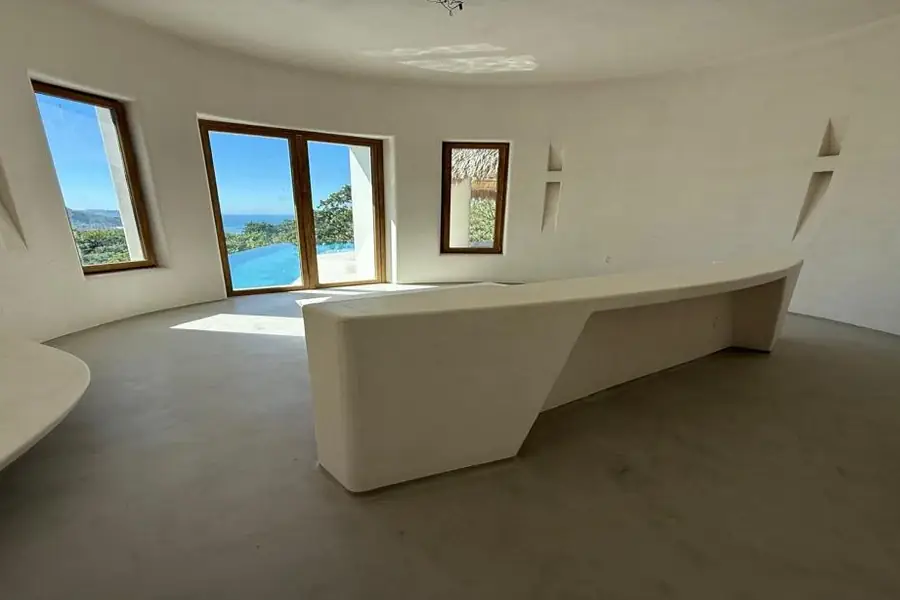
Casa Rosada in Sayulita is the clearest example in the portfolio: polished plaster, stucco and microcement in a range of pinks and terracottas mixed on site until it matched. Several rounds of samples before approval, and the result reads monolithic — walls, niches and arches sharing one surface and one colour with no visible joint. In the same house the infinity pool is chukum: each finish where it belongs.

Materials we apply
- Kimikolor
- Corev
Frequently asked questions
What is the difference between polished plaster and microcement?
Polished plaster is a fine mineral wall coating under a millimetre thick and takes no foot traffic. Microcement is a multi-coat system with sealer, 2 to 3 mm, that can be walked on and goes on floors and in bathrooms. On a decorative interior wall, polished plaster is usually enough and considerably cheaper.
Can it go over paint?
Over sound, well-adhered paint with the right primer, yes. Over paint that blisters, flakes or has moisture behind it, no — it has to come off first. That gets determined on the site visit, by scraping.
Does it hold up outdoors?
Polished plaster holds up in sheltered exteriors, under an eave or on façades that do not take rain head-on. On a directly exposed wall, stucco with a water repellent is better — or chukum if there is also constant water splash.
Tell us what you need
Finishes or maintenance
Microcement, polished plaster, waterproofing or an annual plan. Send photos of the space on WhatsApp and we will give you a range the same day.
WhatsApp usDesign or new construction
Projects with drawings, permits and a line-item budget. We come back with a formal proposal in under five business days.
Request a quote